
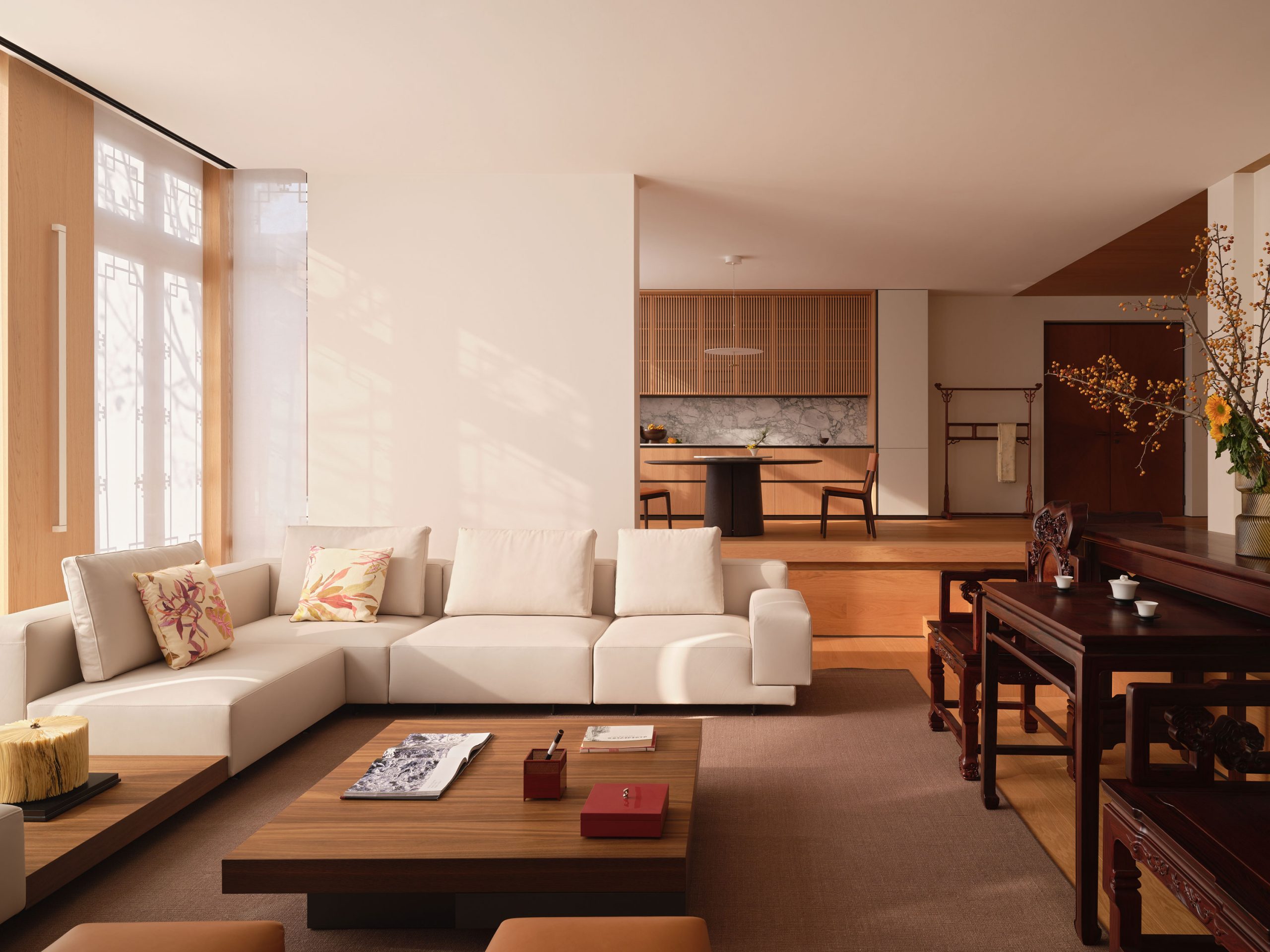
At Pimenli Private Residence, located near Suzhou’s historic Taohuawu district, this idea becomes an immersive and tangible experience. Within a 700 m² courtyard and 1,000 m² interior, designer Zhang Haihua of Z+H Renhai Design creates a refined living environment for a three-generation family. A home where Jiangnan’s poetic landscape and contemporary minimalism quietly merge.

A Contemporary Interpretation of Jiangnan Aesthetics
Upon entering the residence, a soft veil of sheer curtains works like semi-translucent xuan paper. Sunlight becomes a painter; slanted eaves cast nuanced shades; ink-like shadows expand and soften the room. The Designer reinterprets Jiangnan aesthetics not through overt motifs but through purity of lines, restrained materials, and a choreography of light and shadow. The result is a home that is serene yet alive. It’s fluid, breathable, and emotionally resonant.

Where Classical Garden Philosophy Meets Italian Minimalism
The design draws from both classical Suzhou garden philosophy and the principles of Italian minimalism. Here, static space is enlivened by the movement of light. Minimalist furniture coexists with dynamic shadows. A philosophy creating a dual spatial rhythm: stillness versus motion, material versus immaterial.

Over the course of a day, sunlight filters through trees, rippling across the curtains. The architectural planning and furniture arrangement intentionally position people at the best vantage points to observe this shifting natural tableau. By day, windows function as thresholds between nature and interior, creating a living ink-wash painting. By night, the illuminated, minimalist interior resembles an Italian design gallery suspended within a classical Chinese garden.
A concealed visual axis aligns the courtyard’s rockery, engraved stone slabs, living room colonnade, central hall furniture, and the ascending staircase. This spatial sequence reflects both the organizational logic of Jiangnan mansions and the deep cultural order of Confucian tradition.

At dawn, mist hangs lightly in the courtyard. A sofa faces a Ming-style console, forming a subtle dialogue between East and West. The sunken living room heightens the gaze outward—toward Taihu stone textures, bamboo greens, and yellow blossoms. In the dining area, cabinetry and a round table balance elegance with functionality. As morning mist dissipates, the entire residence becomes a three-dimensional landscape scroll.

A Dialogue Between Eastern and Western Craftsmanship
The residence is built upon a collaborative craftsmanship between Suzhou artisans and Italian craftsmen.
The courtyard is shaped by Master Yuan, a seasoned garden craftsman in his sixties. With an instinctive understanding of stone textures, folds, and natural orientations, he composes the rockery by following the inherent grain of each stone. He’s letting geology guide design. Every placement, every angle, is calibrated to echo natural mountain formations.

Inside the home, bespoke Italian cabinetry demonstrates millimeter-level precision. After Chinese craftsmen completed structural preparations, Italian craftsmen traveled to Suzhou to fine-tune installation and detailing. Wardrobe systems are flush-mounted within walls with exceptional accuracy, transforming storage from a utilitarian act into an aesthetic ritual.
“Rational actions can also be poetic” becomes a guiding principle: – The tactile resistance of a drawer gliding open – The temperature shift on silk textiles – The glimpse of a garden through a carved opening. These sensory details together form the quiet narrative of the home.

Ming-style furniture crafted by Suzhou artisans sits alongside hand-polished bronze fittings that echo European metal components. A rare Song-dynasty ceramic piece is displayed in a floating cabinet adjacent to a minimalist coffee table. Here, modern life finds harmony with the memory of an ancient tree in the courtyard; craftsmanship becomes not an ornament, but the essence of luxury.
Eastern Minimalist Humanism: A Living Space Rooted in Culture

Architect Tadao Ando once said that a residence is the purest reflection of long-term living patterns, climate, and local culture. The designer’s vision for Pingmenli is to explore an “Eastern Minimalist Humanism”. A design approach that may form an important paradigm for Chinese contemporary residences on the international stage.
See more images in the gallery below
Project name: Pingmenli Private Residence
Location: Suzhou, China
Completion Year: 2024
Floor Area: 1,000 m²
Landscape area: 700 m²
Design Firm: Z+H Renhai Design
Design Director: Zhang Haihua
Design Team: Wang Xiao, Sun Huihui
Decoration Consultant: uliving
Photography: Cai Yunpu
 English
  Indonesian