
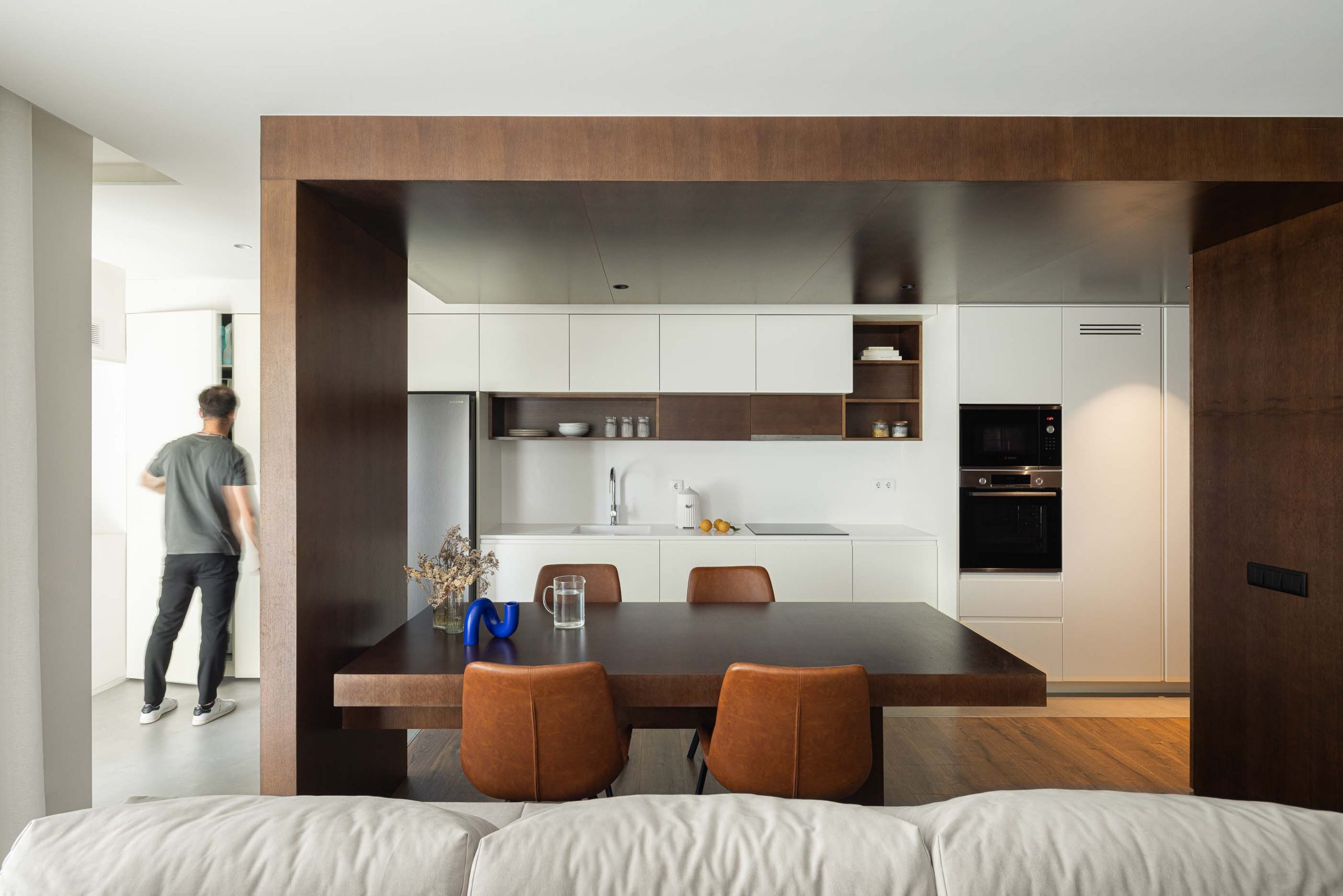
The project transforms a fragmented layout into a continuous interior designed for contemporary living, where work, leisure, and rest coexist. Instead of dividing the space, bespoke elements structure it without closing it off.
The dining table acts as a transitional element between kitchen and living area, while a custom desk, double-sided fireplace and built-in wardrobe reinforce spatial continuity. Microcement brings rigor and unity; walnut introduces warmth and serenity.

The renovation project of FP Apartment, located in São Vicente, Braga, arose from the need to deeply transform an existing dwelling that was in a significant state of degradation, characterized by outdated, cold materials and a language no longer aligned with contemporary ways of living. The client sought a functional, practical and comfortable home, where design and sobriety play a central role in defining the space, capable of responding to a daily routine marked by long periods spent indoors and work carried out from home.

The pre-existing condition was defined by a rigid compartmentalization, aged materials and outdated construction solutions, which limited both spatial fluidity and the quality of everyday living. The intervention addressed these constraints through a clear reorganization of the apartment, promoting a more continuous and integrated spatial reading, suited to a contemporary lifestyle in which work, rest and leisure coexist within the same domestic environment.

The proposal is inspired by a contemporary language, based on the balanced combination of walnut wood and microcement. These materials establish a dialogue between warmth and neutrality, giving the apartment an atmosphere that is simultaneously welcoming and rigorous. Straight and pure lines guide the entire design, while a clear and sober colour palette contributes to a sense of order, serenity and timelessness.

At the core of the project lies a set of custom-designed elements that structure and qualify the space. The dining table, specifically designed for this apartment, plays a fundamental role by acting as a transitional element between the kitchen and the living room, defining uses without resorting to physical partitions. The desk, designed to accommodate work activities, was also custom-made and discreetly integrated into the overall layout. A double-sided fireplace reinforces visual continuity between different areas of the home, while the entrance hall incorporates a bespoke wardrobe that organizes the arrival space and immediately introduces the project’s architectural language.

A high level of detailed design was essential throughout the entire process, allowing careful control over material junctions, built-in furniture and lighting solutions. The construction phase, carried out by a meticulous and highly rigorous building team, was fundamental in accurately materializing the project’s intentions, resulting in a coherent, refined and durable final solution.

FP Apartment reflects a profound transformation of the existing structure, where the contrast between before and after reveals a clear change not only in aesthetic terms, but above all in the way the space is lived. A previously fragmented and outdated apartment gives way to a contemporary, functional home, carefully designed to respond in a balanced manner to the demands of everyday life.

See more images in the gallery below
Project name: FP Apartment
Architecture Office: ARQUITECTOS RT
Main Architect: RICARDO PEREIRA E TIAGO COSTA
Client: Francisco Pimentel
Location: SÃO VICENTE, BRAGA
Year of conclusion: 2024
Total area: 130 m²
Architectural Photographer: Ivo Tavares Studio
 English
  Indonesian