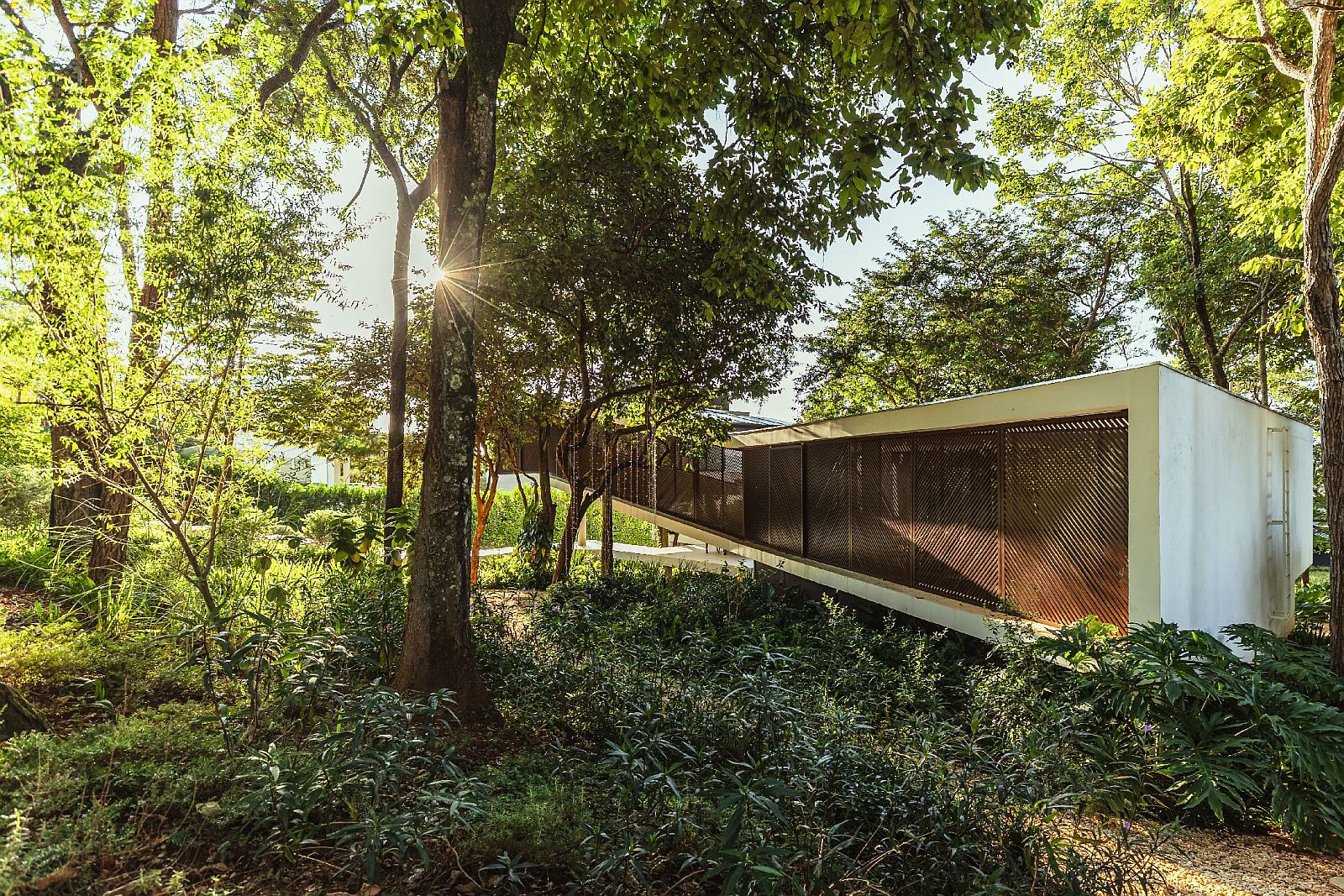
The Ascendente House was conceived from a reading of the voids between existing trees, adopting an approach of careful insertion and preservation. Its massing is organized in levels that follow the site, establishing a clear hierarchy between social, private, and service areas, while keeping the house continuously connected to the garden and vegetation.

The main entry occurs at ground level, where living room and kitchen form a single integrated space. This area works as the core of circulation and daily life, with openings oriented toward the interior of the lot, encouraging filtered views, cross-ventilation, and a direct relationship with the landscape design. Also on this level, two guest suites are accessed from a covered outdoor veranda, creating a semi-open route that reinforces a gradual transition between exterior and interior and grants independence to the rooms.

Vertical circulation is resolved through a stair-ramp, conceived as an architectural element that links the levels and gives form to the program’s “ascent.” Along this path, the main suite is reached, set on an upper elevation and oriented toward the rear of the site, where the view becomes broader and less obstructed. Bedroom, terrace, and bathroom form a single composition facing the landscape, with openings sized to favor natural light and framed vistas.

On the front façade, a mashrabiya acts as a second skin: it controls sunlight, ensures privacy, and unifies the reading of the volume, while still allowing ventilation and diffuse light. On the lower level, beneath the guest suites, the garage and service areas are concentrated, freeing the main spaces for contact with the garden.

The pool is set within a clearing on the site, connected by a deck slightly lower than the ground floor, shaping an outdoor living area sheltered by the tree canopy. The project seeks a balance between environmental performance, privacy, and spatial continuity, making nature not a backdrop, but part of the architecture itself.

A key feature of the project is the swimming pool, which is positioned within a natural clearing on the site. Connected to the house by a deck set slightly below the ground-floor level, the pool area forms an inviting outdoor living space. Protected by the canopy of existing trees, this environment offers shade, comfort, and a unique sense of immersion within the landscape.

Ultimately, The Ascendente House seeks a balance between environmental performance, privacy, and spatial continuity. By organizing its massing according to the site’s contours and maintaining a constant dialogue with the surrounding vegetation, the project transforms nature into an integral architectural component. Here, the landscape is not a backdrop to the house but an active participant in shaping the experience of living within it.

The name “Ascendente” reflects the architectural concept of ascending through the landscape, where a sequence of stepped volumes follows the site’s natural topography and gradually reveals broader views of the surrounding environment.
See more images in the gallery below
Multiple drawings are provided below for reference
Project name: Casa Ascendente / Ascendente House
Architecture: TETRO
Responsable Architects: Carlos Maia, Débora Mendes, and Igor Macedo
Contributors: Guilherme Castro, Bianca Carvalho, Luisa Lage, Sabrina Freitas, Márcia Aline
Location: Lagoa Santa, Minas Gerais, Brasil
Year of conclusion: 2025
Plot Area: 1055 m²
Total Built Area: 274 m²
Photography: Luisa Lage
Architectural Model Images: Alice Girardi