Where Blackbirds Return: A Pentagonal House Rooted in Memory and Light

This house emerged from the transformation of a ruin that had marked the landscape for decades. Its name evokes the blackbirds that gave identity to the old village, a reference that is reflected in details such as the sculpture above the entrance and decorative paintings that pay tribute to these birds.

The house was designed with reference to the old threshing floor, which influenced the spatial organization. The bedrooms and living room are arranged around strategic voids in the volume, allowing different incidences of natural light throughout the day. Some openings were positioned to frame views of the Castle of Ourém, reinforcing the connection between the project and its historical context.

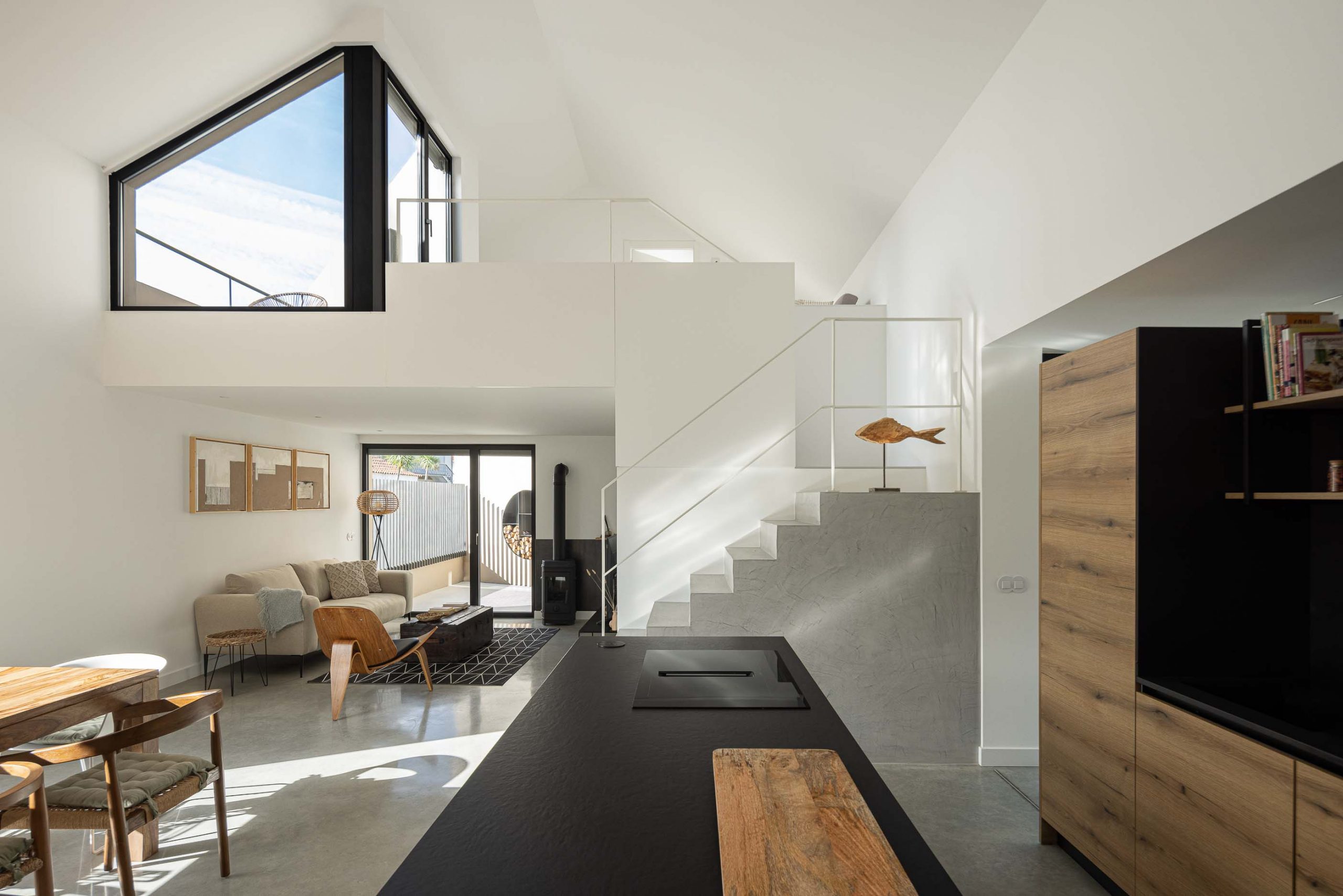
The double-height ceiling creates a spacious spatial experience.

Built upon a pre-existing structure, the “Casinha da Melroeira,” located in Ourém, follows the same volumetric language as the “Casa da Melroeira,” situated on the adjacent plot. The two houses are connected by their pentagonal form; however, their scale and relationship with the context differ, resulting from their interaction with the immediate surroundings.

The house not only offers a warm and welcoming atmosphere, but also embodies a strong sense of sustainability.

The design process of this dwelling was unique due to the familiarity with the place and the lasting image of the ruin that was an integral part of the landscape of Casa da Melroeira—the home of the architect. The symbolic weight of the ruin was always associated with the antiquity of the construction but, above all, with the threshing floor that once existed in front of the house, near the public road. It was this element that defined the starting point for the design of the Casinha: a house that develops around this center, towards which the main spaces—bedrooms and living room—are oriented.

Various paintings depicting blackbirds.

Volumetrically, the limits of the pre-existing structure were maintained. Given the reduced size of the plot, voids carved into the mass of the volume allowed for the creation of diverse outdoor spaces that complement the interior use. These voids were deliberately not cut orthogonally to the exterior walls. Their orientation was determined by a search for different angles of natural light, allowing the interior spaces to experience varying atmospheres throughout the day. Additionally, the positioning of certain openings, namely in the office and the bathroom on the second floor, is strategically directed towards the Castle of Ourém, creating a framed view for those observing from inside.

Voids carved into the building mass allow for the creation of diverse outdoor spaces that complement the interior functions.

As there was no final client for whom the house was designed, the challenge became the object itself: preserving the memory and presence of the house within its context while exploring the relationship between the body and family life in a compact space, without compromising the quality of spatial connections and the comfort of each environment.

Several handcrafted objects were created by the architect himself, including the blackbird sculpture placed in the niche above the entrance.

Moreover, the circumstances allowed the project to become an experimental exercise—not only in terms of design, with details expressed in exterior metalwork (mailbox, railings, gargoyles, chimney, or even the firewood storage) but also in technical and construction solutions that enabled the volume to achieve continuity between walls and roof.

The bedrooms and living room are arranged around strategic voids within the building mass.

When we think of home, we inevitably associate it with a sense of refuge and a space that emotionally contributes to our well-being. Upon entering the Casinha, the immediate presence of a double-height ceiling—taking advantage of the pentagonal form of the volume—creates a spatial experience that conveys a great sense of openness, emphasized by depth and height. This space then leads to other moments that, in contrast to the first, adopt a more intimate scale that embraces its inhabitants.

The house was designed to preserve its memory and presence within the surrounding context.

Inside, the house thrives on this spatial diversity; however, the objects that compose it play a significant role. Several pieces of furniture were sourced from antique shops, natural elements were used as decorative pieces, and handcrafted objects were created by the architect himself. These include the blackbird sculpture placed in the niche above the entrance—a reference to the village of “Melroeira,” named after the abundance of blackbirds in the area—the various paintings depicting blackbirds or perspectives of the house, the handmade mezzanine lamp, and the repurposed dining room light fixture. These elements coexist harmoniously with simple, commercially available decorative pieces and even the Shell chair by Hans Wegner, also acquired second-hand.

The house was designed with reference to the traditional threshing floor.

This balance between memory, innovative technical solutions, and the recycling and reuse of elements grants the house not only a warm and welcoming atmosphere but also a distinct sense of sustainability.

See more images in the gallery below


Multiple drawings are provided below for reference


Project name: Casinha da Melroeira
Architecture Office: Filipe Saraiva - Arquitectos
Main Architect: Filipe Saraiva
Collaboration: Arq. Samuel Silva, Arq. Jéssica Casalinho

Location: Rua Nossa Senhora do Amparo No 424, Melroeira, Ourém, Portugal
Year of conclusion: 2024
Total area: 116,10 m²

Construction: L&L
Inspection: Martins & Reis, Lda.
Engineering: Eng. Sílvia Vieira, and Eng. Carla Coutinho
Light Design: Eng. Carla Coutinho
Acoustic Design, Fluids Engineering,Thermal Engineering: Eng. Sílvia Vieira
Visual identity, Interior Design: Arq. Filipe Saraiva

Architectural Photographer: Ivo Tavares Studio

READ MORE

error:
en_USEnglish