
The enthusiasm among Jakarta residents and commuters using MRT Jakarta continues to grow. According to PT MRT Jakarta (Perseroda), MRT Jakarta Phase 1 has carried approximately 46 to 47 million passengers per year, reaching 46.5 million passengers in 2025 and around 47 million passengers during the latest one-year operating period. On average, the service carries more than 127,000 to 137,000 passengers daily.
For the ongoing MRT Jakarta Phase 2A project, PT MRT Jakarta (Perseroda) is striving to exceed its construction targets.
MRT Jakarta Phase 2A stretches 5.8 kilometers from Bundaran HI to Kota. This phase features Indonesia’s first stacked underground tunnel, the country’s deepest station, and integration with heritage sites.
Here are the key construction milestones and engineering challenges of MRT Jakarta Phase 2A.
Indonesia’s First Stacked Tunnel
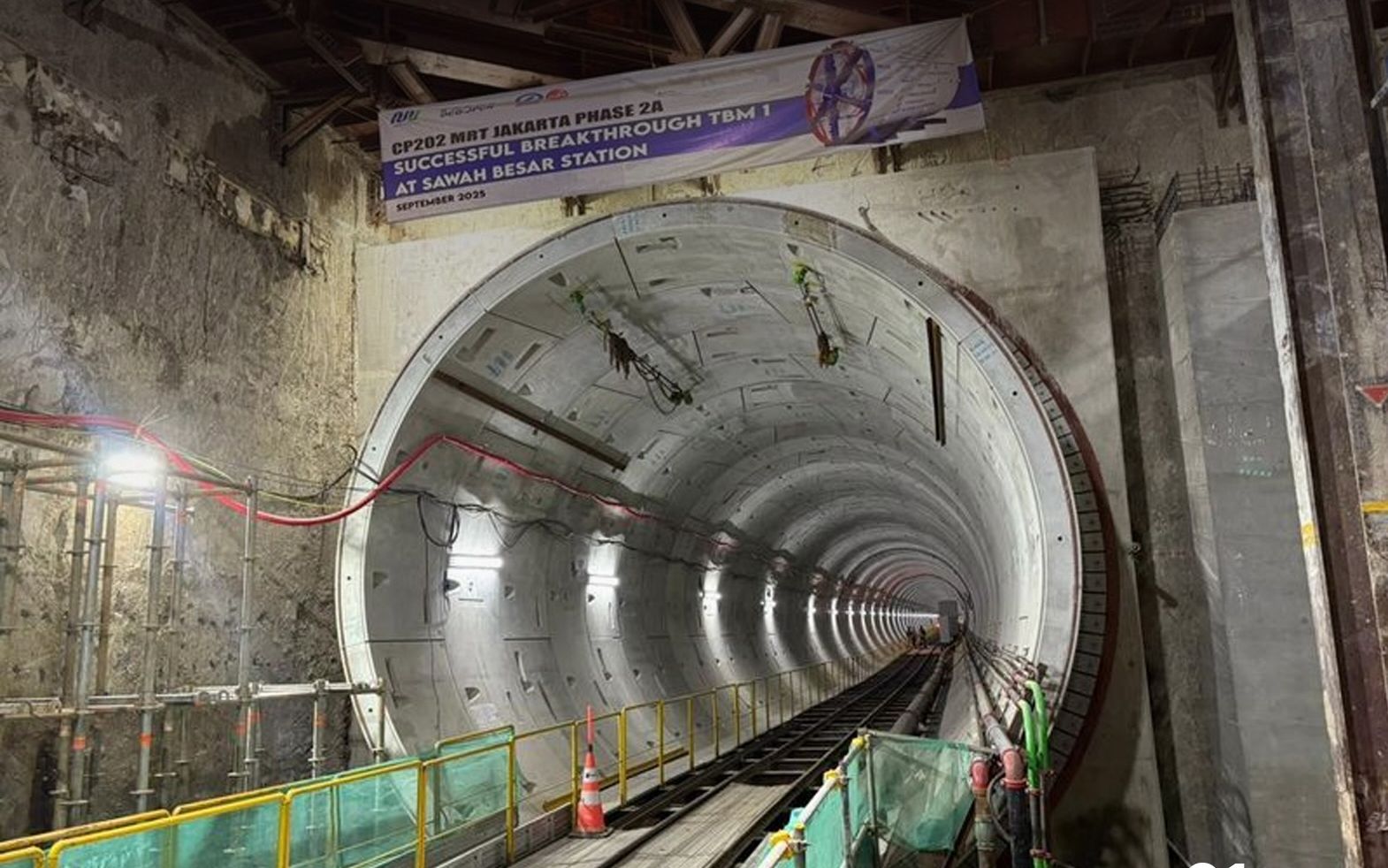
Indonesia’s construction industry has made history with the successful development of the country’s first stacked tunnel and stacked station. This approach was adopted to overcome limited land availability and the dense concentration of underground utilities along the Gajah Mada and Hayam Wuruk corridors. The northbound and southbound tunnels are therefore arranged vertically, one above the other. The stacked configuration is implemented between Harmoni MRT Station and Mangga Besar.
“Besides the limited land availability and dense concentration of road utilities in the Gajah Mada and Hayam Wuruk areas, the two areas are also separated by the Ciliwung River. To construct the tunnel, workers had to wait for the dry season because concrete sheet piles had to be installed at the bottom of the river. We scheduled the work when the water level began to recede,” —Weni Maulina, Construction Director of PT MRT Jakarta (Perseroda).
This contrasts with MRT Jakarta Phase 1, where the northbound and southbound tracks run parallel side by side. Similarly, the platforms are located on the same level or floor within the stations.
READ ALSO: MRT Jakarta Phase 2A Progress
The challenges of constructing the stacked tunnels include:
Dense urban environment: The Gajah Mada and Hayam Wuruk corridors are surrounded by numerous buildings and extensive underground utilities, making it impossible to construct the northbound and southbound tracks side by side.
Soft ground conditions: The soil characteristics in this part of Jakarta are relatively soft, requiring the tunnels to reach an extreme depth of up to 28 meters. MRT Jakarta’s tunnels are excavated using massive Tunnel Boring Machines (TBMs).
“There were many challenges we faced during construction, but at least four were the main ones: the narrow road space, soft soil conditions that required soil improvement, the presence of pipe and cable utilities, and the discovery of cultural heritage artifacts. Despite these challenges, we were able to complete the work ahead of the target,” — Tuhiyat, President Director of PT MRT Jakarta (Perseroda).
Deepest Underground Station in Indonesia
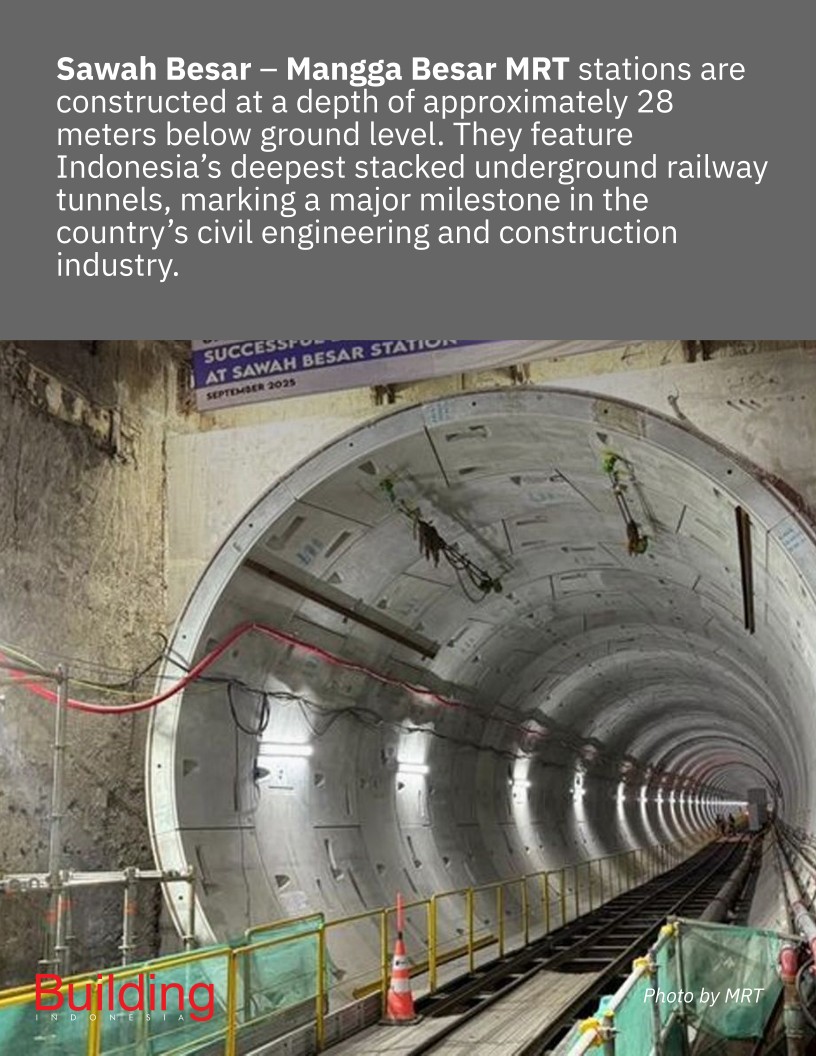
Located in the densely built-up city center, Sawah Besar–Mangga Besar Station is being constructed at a depth of approximately 28 meters below ground level. The Sawah Besar–Mangga Besar underground section will become Indonesia’s deepest underground railway tunnel, constructed in a stacked configuration—marking a major milestone in civil engineering in Indonesia.
“After passing Harmoni Station toward Kota Station in the northbound direction, the Ratangga train, which was initially traveling through tunnel two, will move into tunnel four, namely the Sawah Besar–Mangga Besar Station tunnel, at a depth of 28 meters,” — Sonny Desta Primandani, Division Head of PMC 1 at MRT Jakarta (Perseroda).
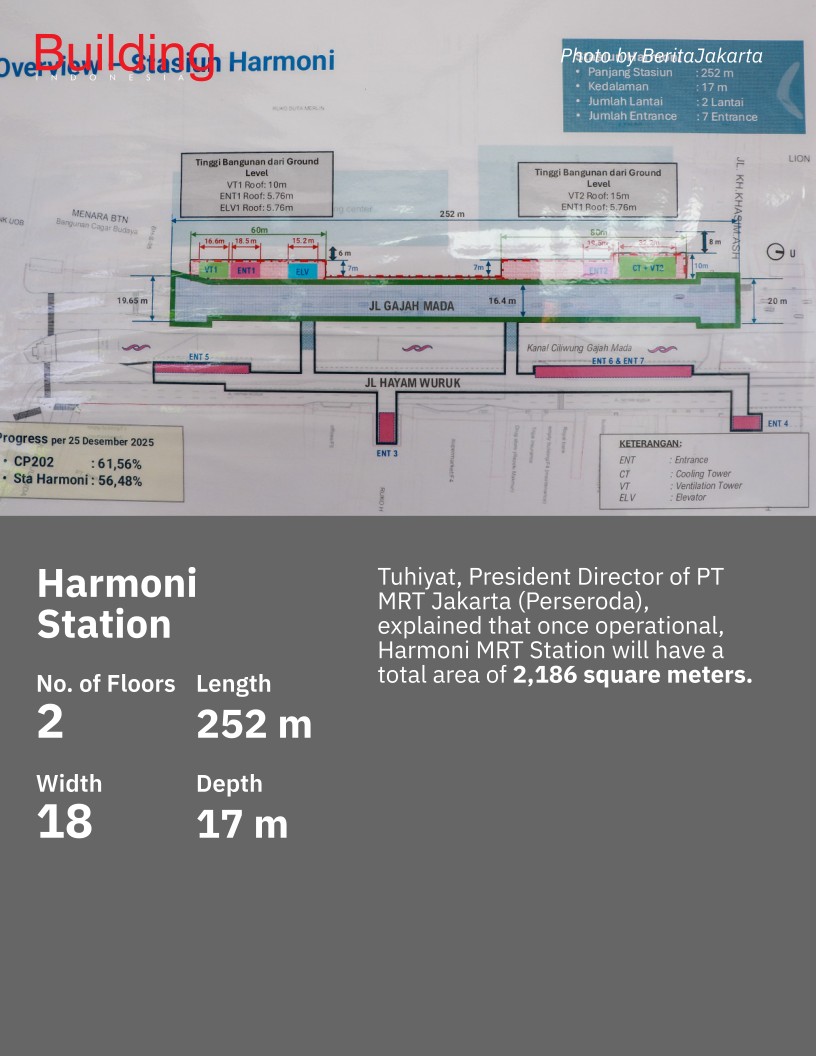
Harmoni Station
Number of floors: 2
Length: 252 meters
Width: 17-18 meters
Depth: 17 meters
Number of entrances: 7 (4 on sidewalks, 3 integrated with TransJakarta bus stops)
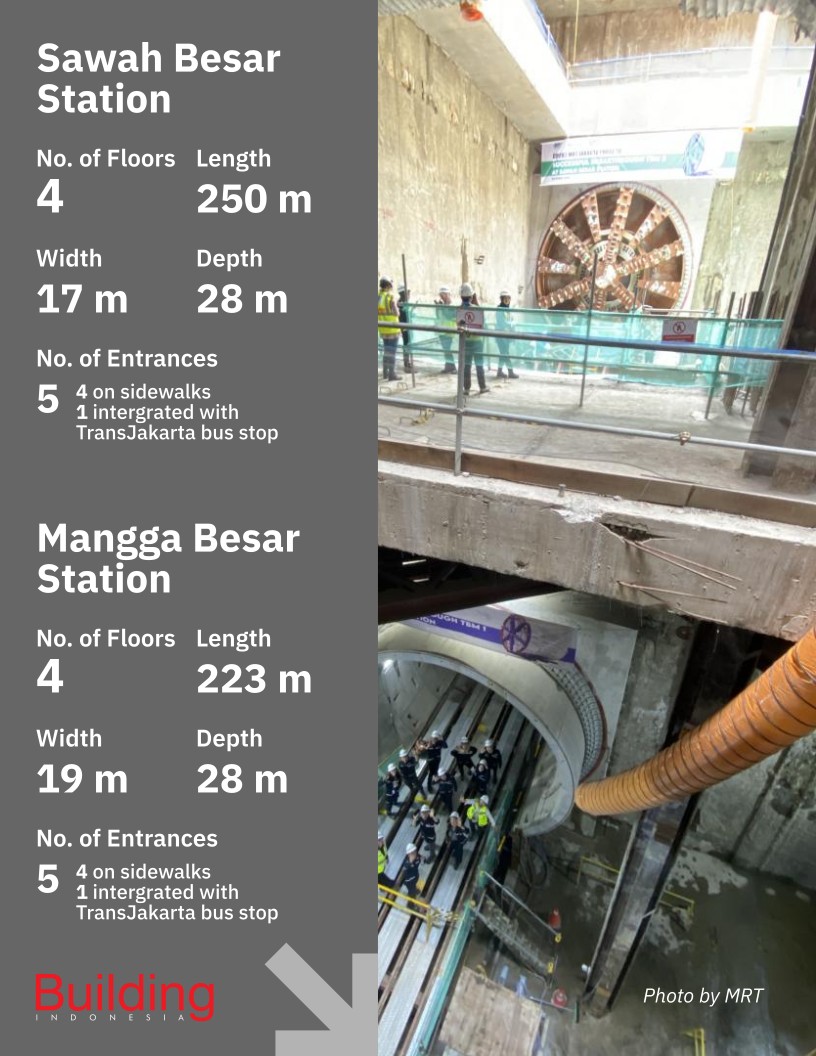
Sawah Besar Station
Number of floors: 4
Length: 250 meters
Width: 17 meters
Depth: 28 meters
Number of entrances: 5 (4 on sidewalks, 1 integrated with a TransJakarta bus stop)
Mangga Besar Station
Number of floors: 4
Length: 223 meters
Width: 19 meter
Depth: 28 meters
Number of entrances: 5 (4 on sidewalks, 1 integrated with a TransJakarta bus stop)
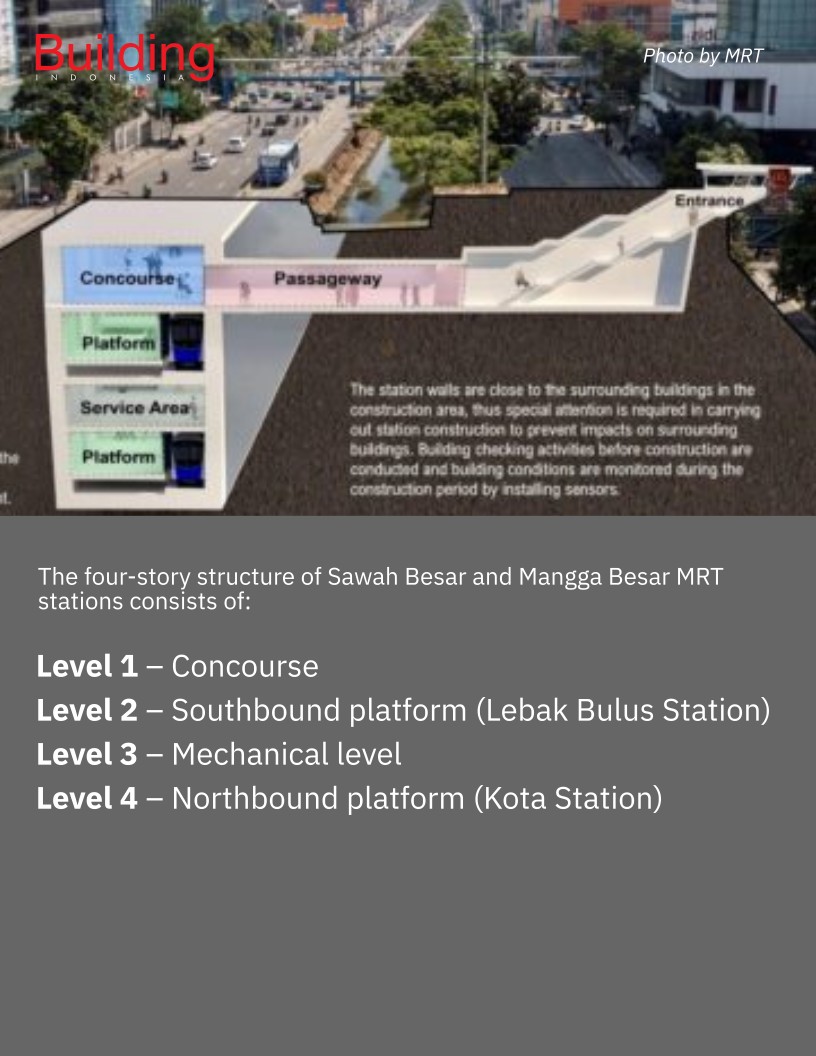
The structure of these four-story stations consists of:
Level 1 – Concourse
Level 2 – Southbound platform (Lebak Bulus Station)
Level 3 – Mechanical level
Level 4 – Northbound platform (Kota Station)
By comparison, in MRT Phase 1, the deepest station is Dukuh Atas MRT Station, located approximately 24 meters below ground level.
The Grandest and Longest Station
Thamrin MRT Station is set to become the longest MRT station, measuring approximately 455 meters and featuring eight entrances. It will also be directly integrated with Dukuh Atas MRT Station and various other modes of transportation.
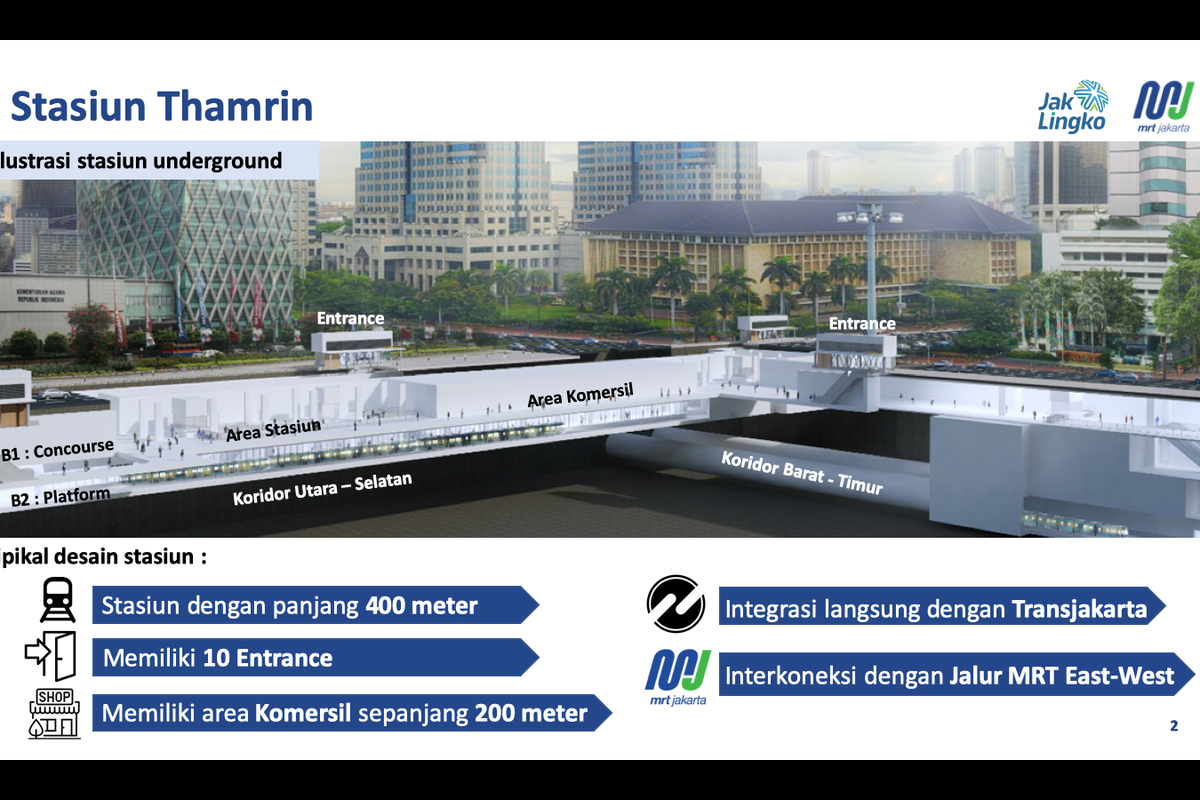
The total length of Thamrin MRT Station reaches 455 meters, extending from the Hotel Sari Pacific area to near the Ministry of Energy and Mineral Resources (ESDM) office. The entire station is located beneath Jalan MH Thamrin in Central Jakarta, at depths ranging from 17 to 36 meters below ground level. The station also includes a 200-meter-long area designated for commercial use.
Thamrin Station Will Integrate the North–South and East–West Lines
Thamrin Station will serve as an interchange between the North–South and East–West corridors. As a key interchange station, it will feature multiple access points or entrances, as well as cooling tower ventilation (CTV) structures.
Construction has reached the final finishing stage, with the station targeted to begin serving the public in 2027.
Massive Intermodal Integration
Harmoni MRT Station will be constructed as a massive two-level underground facility and directly integrated with an elevated Transjakarta Bus Rapid Transit (BRT) stop, allowing passengers to transfer easily between modes.
Harmoni MRT Station will be 252 meters long and feature seven entrances along Jalan Gajah Mada and Jalan Hayam Wuruk, providing access to the underground station at a depth of approximately 17 meters below ground level.
Heritage Conservation
The construction route passes through areas containing historic heritage buildings along the central-city corridor. These structures must be carefully protected to prevent damage during construction.
MRT Jakarta project workers discovered a heritage feature in the form of an old tram track dating back to the Dutch colonial era in 1869. The tracks were discovered on Wednesday, November 9, 2022. Archaeologists from the Jakarta Provincial Cultural Office and the University of Indonesia subsequently began gradually excavating approximately 100 meters of the tram tracks before transferring them to a temporary storage facility owned by Perum PPD in Jelambar, West Jakarta.
History-Inspired Design in the Old Town
For the Glodok–Kota package, the MRT station is being designed around the iconic “Dawara Batavia” concept. The station will feature an underground gallery showcasing archaeological artifacts.
Construction of MRT Jakarta Phase 2A package CP203, Glodok–Kota, continues to show positive progress, reaching 86.03 percent completion as of July 22, 2026. Beyond providing new connectivity, the project is also designed to revive the historic identity of the Kota Tua area through the iconic “Dawara Batavia,” or “Gateway to Batavia,” concept.
Phased Operational Targets
The section from Bundaran HI to Monas is targeted for completion and commencement of operations by the end of 2027.
Meanwhile, the entire route extending to Kota Station is targeted to begin commercial operations by the end of 2029.
 English
  Indonesian